News
THERE IS NO THERE THERE
Curated by Gürsoy Doğtaş and Susanne Pfeffer
Museum für Moderne Kunst, Frankfurt
In the 1960s, ’70s, and ’80s, numerous artists from abroad were working in both the German Democratic Republic and the Federal Republic of Germany. Within the framework of grants and bilateral cultural agreements, and alongside migrant workers, exiles, and refugees, they came to a divided Germany during the Cold War to continue working on their art and to collaborate and exchange with other artists. Some were themselves migrant workers who only later became artists. Memories of people and landscapes, colors, forms, and visual traditions found their way into their works. Fleeing their native countries and living in exile in their new homeland, political conditions as well as daily work and life became their new pictorial themes. Marginalized within the institutionalized art world due to structural exclusions, the artists nevertheless decisively expanded the discourses on art in both post-National-Socialist Germanys. In doing so, they opened up the possibility of seeing different things and, hence, seeing differently. The exhibition There is no there there testifies to the richness of their artistic work and the transformative power that works of art can unleash. While what they left behind inevitably changes, the artists directly change the present.
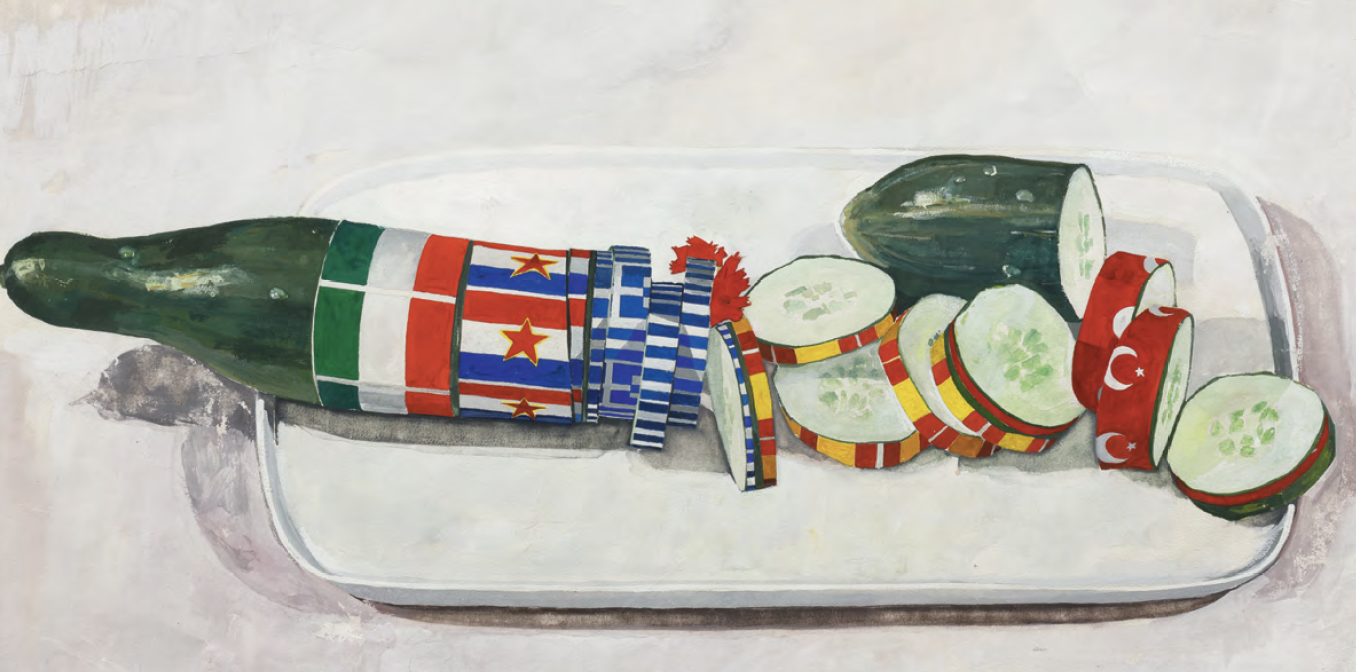
Vlassis Caniaris (1928–2011) produced works that reflected the realities, dreams, situations, and potential viewpoints of economic migrants who moved to western Europe in search of a better life in the 1960s and ’70s. Even before his scholarship in West Berlin from 1973 to 1975, funded by the German Academic Exchange Service (DAAD), the artist addressed the theme of migration while living in Paris. Caniaris created environments with life-sized dolls that he made himself. He used wire frames, plaster, and glue to form their bodies and clothed them in worn-out fragments
of garments held together with pins. The figures are missing human characteristics: some have no hands while the head is absent from others, or some have cans of food forming their shoulders.
One example of this kind of environment is the work titled Hopscotch (1974). Hopscotch is a traditional outdoor children’s game that requires nothing more than a simple flat surface. The hopscotch court is often marked out on
paths or paved surfaces as a sequence of numbered boxes arranged in a particular shape. This hopping game is typically played with a small stone or other such object, which is thrown and marks the space where it lands. Players
aim to hop onto all the spaces in the correct order without losing their balance. When a player makes a mistake,
their turn passes to the next player. In Vlassis Caniaris’ installation, however, there are words in the spaces rather than numbers, such as “Ausl.nderpolizei” (Immigration police), “Wohnsituation” (Living situation), “Akkordarbeit”
(Piecework), or “Konsulate” (Consulates), which describe the various steps and mechanisms involved in economic
migration policy.
The artist’s socio-critical environments presenting scenes concerning migration address issues such as exploitation,
discrimination, national affiliation, and the removal of fundamental rights in the Federal Republic of Germany. The social and political structures of migration and identity permeate Caniaris’ work, reflecting the desire for dialogue.