News
31. ROHKUNSTBAU
The 31st ROHKUNSTBAU explores the “art of transgression” and asks: What is the new? And how does it come into the world? This year’s exhibition explores the possibilities and limits of transforming the existing. It focuses on the perspective of those acting within a pre-structured order—in short, on the logic of transcending the given to arrive at something new.
At the same time, the 31st ROHKUNSTBAU will fuel legitimate doubts as to whether everything that is new is necessarily better, thereby putting modernity’s paradigm of progress to the test. For does change toward something new necessarily mean progress? Or is change perhaps simply, quite banally, the result of moving beyond the given toward a different state? How, then, should this “other” be evaluated? And would it necessarily be new?
The 31st ROHKUNSTBAU focuses on social change, on maneuvers to overcome interpersonal boundaries and barriers and the creation of new interactive relationships and forms of cooperation, on technological innovations such as artificial intelligence, and, last but not least, on artistic strategies for overcoming traditional habits of seeing and hearing. The 31st ROHKUNSTBAU asks: What constitutes the “art of transgression”?
The installation by Silvian Der Meguerditchian was conceived as a direct response to a public lecture by the French artist Annette Messager at the Hamburger Bahnhof – Nationalgalerie der Gegenwart in 2025, which the artist attended in person. Messager, whose work has profoundly accompanied and influenced Silvian since the beginning of their artistic practice, reflected on her seminal installation Le Repos des Pensionnaires (1971–72)—a haunting assemblage of small knitted garments made for dead birds that became a defining work within her oeuvre.
This encounter resonated deeply with Silvian Der Meguerditchian and sparked the decision to revisit and recontextualize an earlier installation originally created in 2014 and exhibited in Istanbul and Diyarbakır.
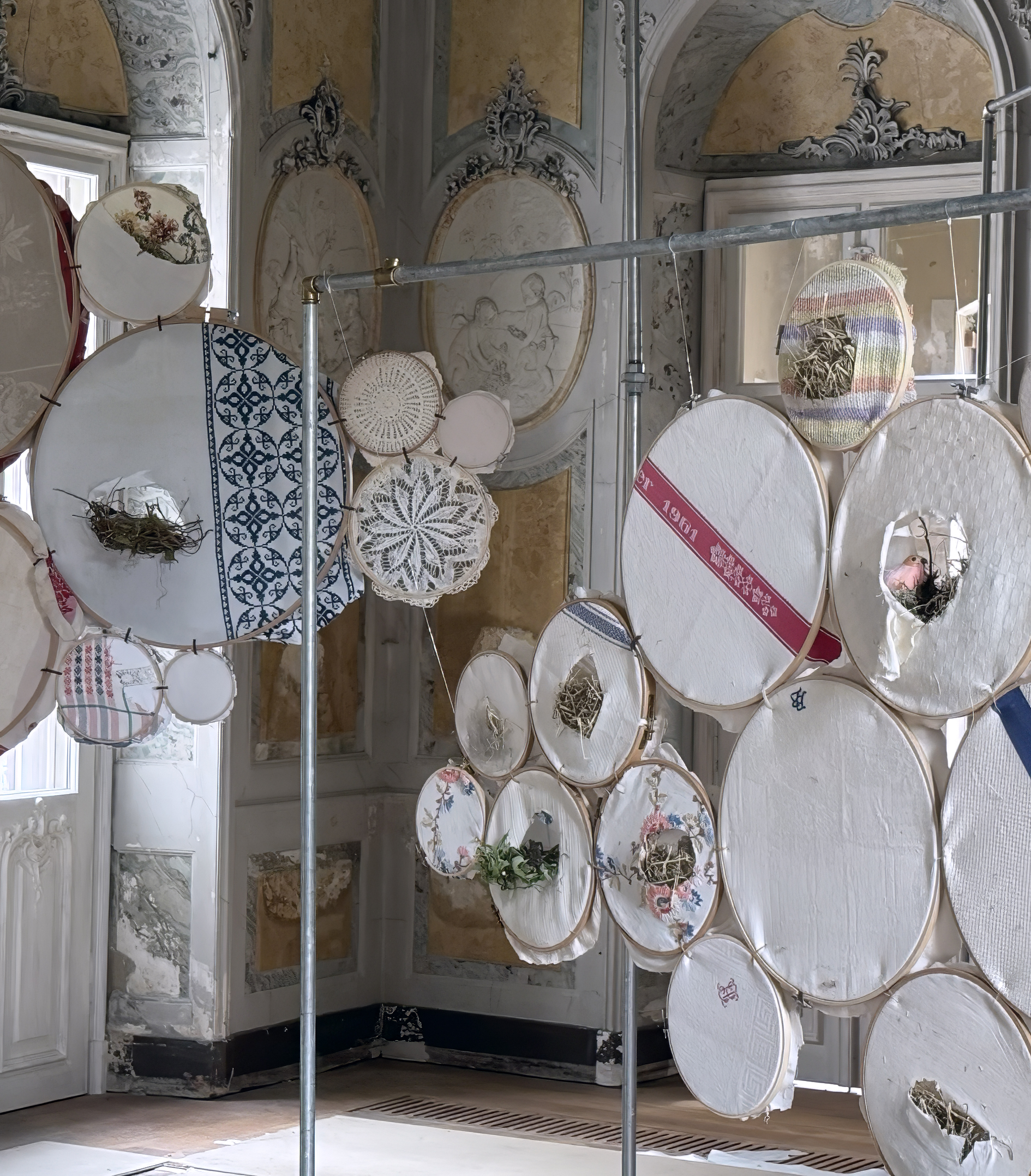
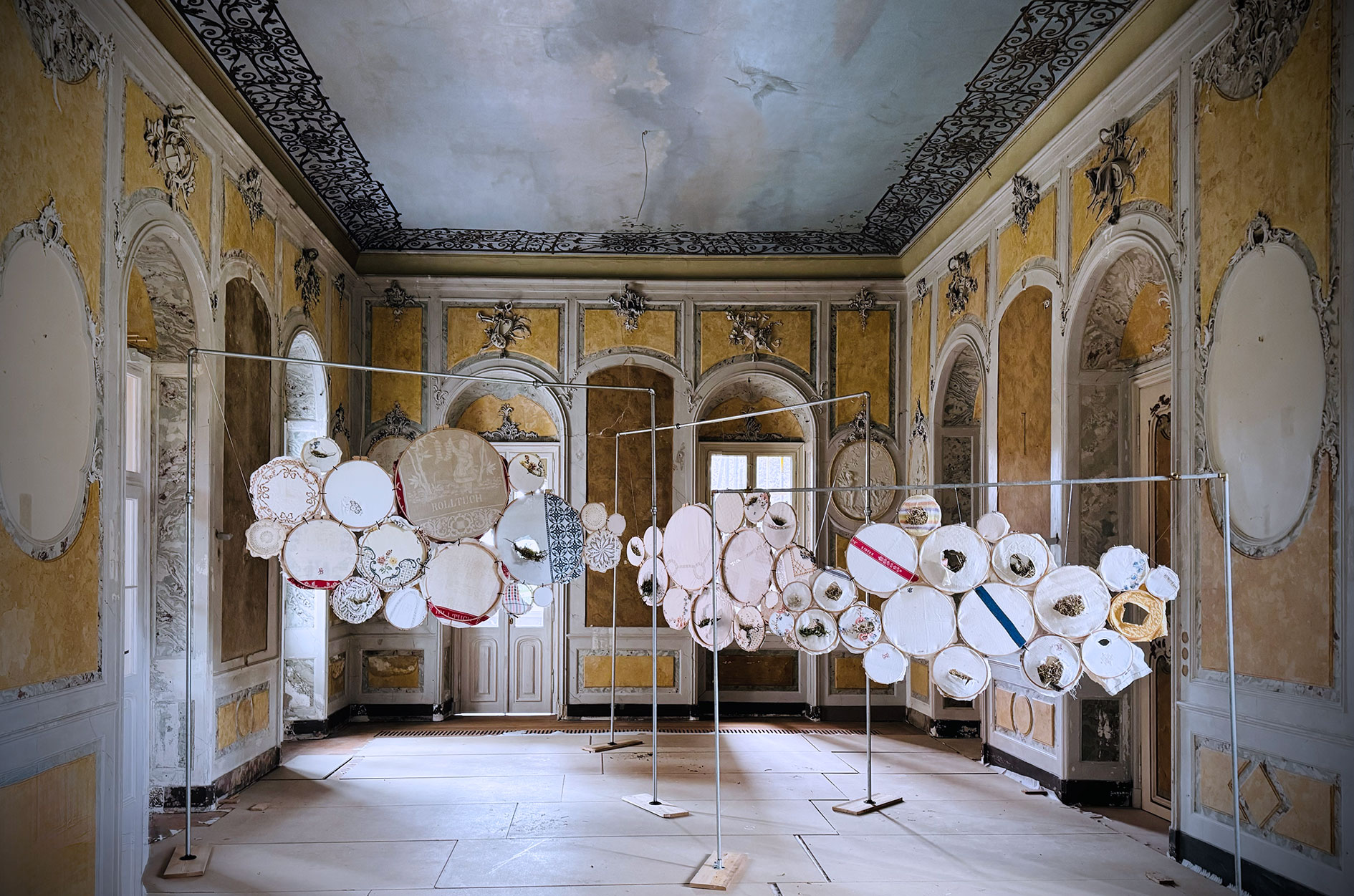
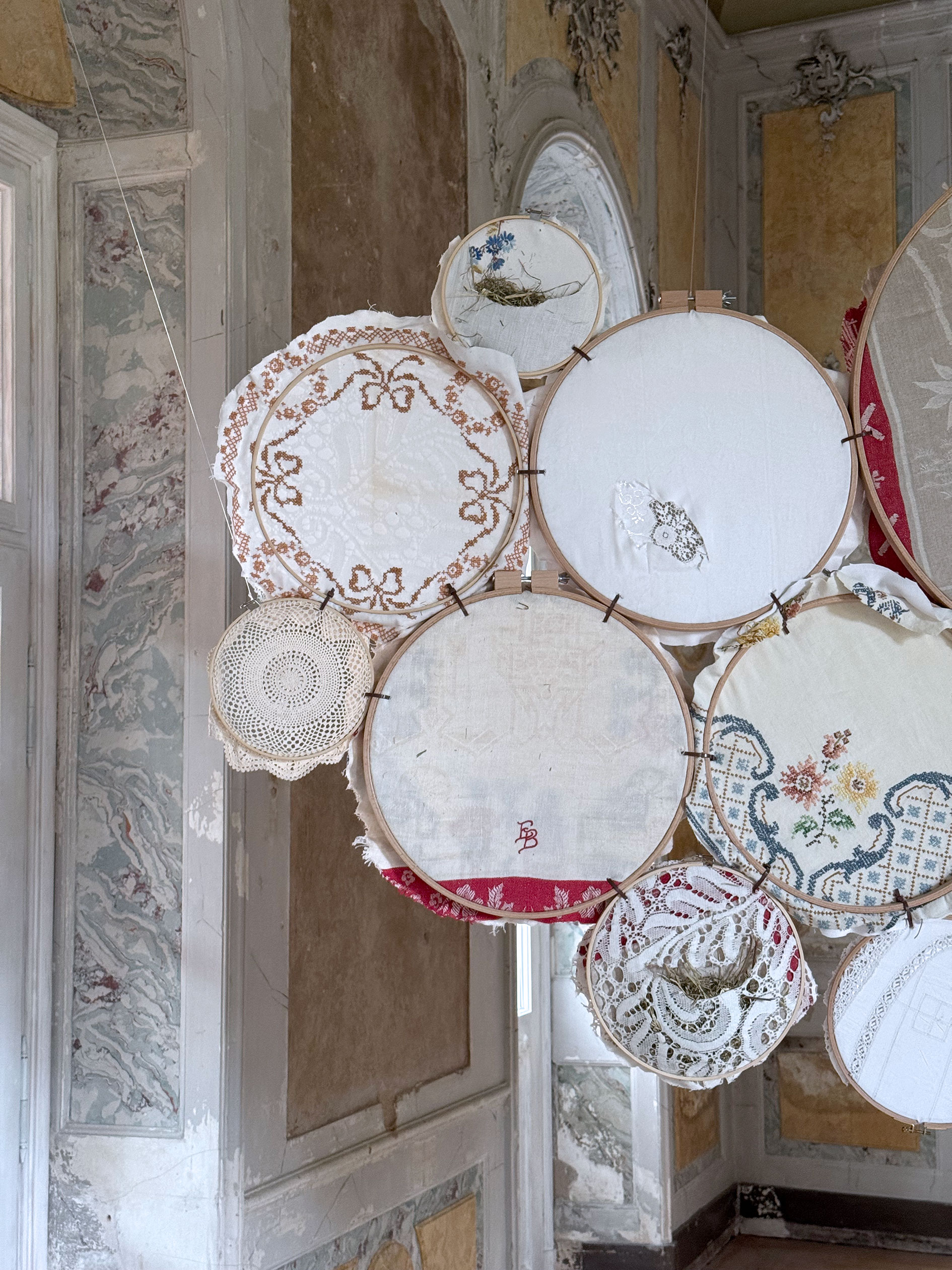
The original 2014 work consisted of a series of circular embroidery hoops mounted directly onto the wall. Each hoop contained fragments of domestic textiles—tablecloths, bedsheets, napkins—materials associated with intimacy, memory, and everyday life. Some fabrics were embroidered, others carried intricate woven patterns. Yet all shared a common feature: a tear, a rupture, a visible wound inscribed into the fabric itself.
Accompanying these textile works was a gilded metal detector presented as a ready-made object. This element referenced the phenomenon of so-called “treasure hunters” in Turkey who, in the aftermath of the Armenian Genocide and deportations of 1915, continue to search for hidden valuables believed to have belonged to displaced and murdered Armenians. The metal detector thus became a symbol of a disturbing historical afterlife: the desire to extract from the earth what was violently taken from those who were erased. It points to a perverse intersection of violence, repression, greed, and the unresolved legacy of historical trauma.
By returning to this earlier work through the lens of Messager’s reflections, Silvian Der Meguerditchian creates a renewed dialogue between memory, absence, mourning, and materiality—inviting viewers to confront the traces of loss that persist within both personal and collective histories.